Bauhausbücher

Overview
editorial Overview
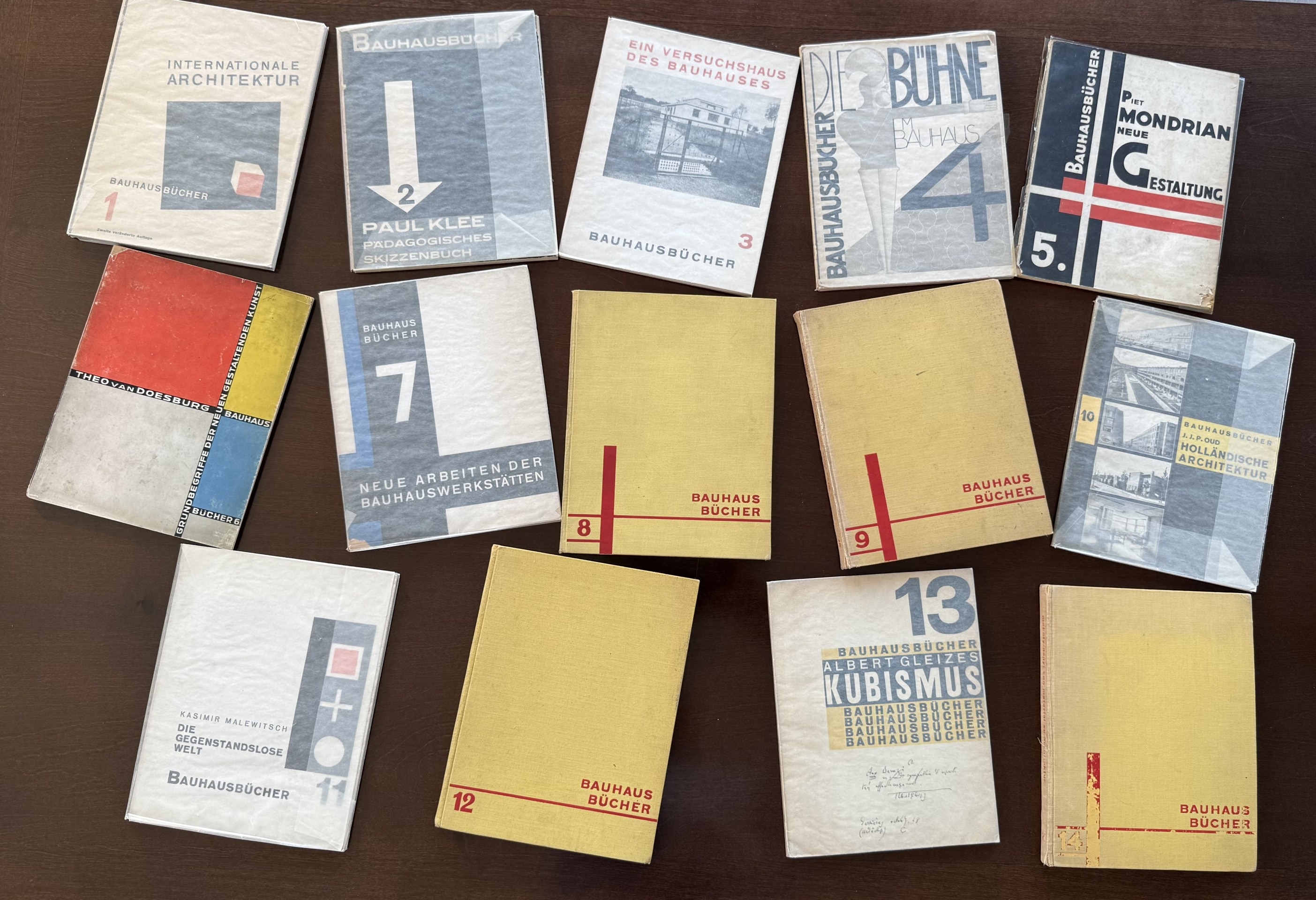
Between 1925 and 1930, fourteen volumes were published under the title Bauhausbücher, initiated by Walter Gropius and László Moholy-Nagy.
This series represents a collective editorial project, bringing together contributions from major Bauhaus figures : Paul Klee, Kandinsky, Schlemmer, Albers, among others. Each volume explores a distinct field—architecture, pedagogy, photography, theatre, urbanism—while sharing a unified formal rigor. Layouts are functional, typography is clean, and images are selected with precision. The book becomes a space for demonstration, a tool for thought, a graphic manifesto. Preserved in institutions such as the Bauhaus-Archiv and MoMA, these volumes are now considered key milestones in modernist publishing and interdisciplinary thinking.
context
Context of Publication
“Modern architecture should not be a style, but the expression of our time.” — Walter Gropius
The publication of the Bauhausbücher occurred during a period of upheaval: in 1925, the Bauhaus was forced to leave Weimar for Dessau under political pressure. Gropius and Moholy-Nagy conceived the series as a means of transmission, but also as an act of intellectual resistance. In a Germany marked by conservative retrenchment, these books assert the legitimacy of the modernist project. They articulate theory and practice, discipline and experimentation, and reflect a collective ambition : to position art as a tool for social transformation. Far from technical manuals, they embody an editorial utopia, where the book becomes a space for pedagogy, creation, and engagement.
Position
Position in the History of Ideas
“The Bauhaus is not a style, it is a method.” — László Moholy-Nagy
The Bauhausbücher belong to the European modernist movement, but their scope transcends aesthetic classifications. They reflect an interdisciplinary approach, where art, architecture, design, and pedagogy are conceived as a unified whole. The Bauhaus advocated for a functional aesthetic, attuned to social needs. These volumes express that ambition : each one articulates a method, a vision, an experiment. Kandinsky develops an abstract visual grammar; Moholy-Nagy theorizes photography as a perceptual language. These books do not codify a style—they propose a way of thinking, transmitting, and creating in a world undergoing transformation.
Reading
Critical Reading of the Series
“Art does not reproduce the visible ; it makes visible.” — Paul Klee
The Bauhausbücher read as a constellation of visual reflections. Each volume stands alone, yet all share a common imperative: to make art intelligible, active, and transformative. Klee proposes a pedagogy of movement; Moholy-Nagy sees photography as a sensory tool; Kandinsky theorizes the point as an expressive unit. These reflections are embodied in rational layouts, clear typography, and carefully selected images. The book becomes a space for thought, where form fully serves content. These volumes do more than transmit knowledge—they shape a way of seeing, thinking, and living art as necessity.
Insight
curatorial note
A visionary editorial project — thinking, structuring, transmitting The Bauhausbücher series stands as one of the most ambitious editorial undertakings of the twentieth century.
Conceived between 1925 and 1930, it embodies the spirit of the Bauhaus : formal clarity, interdisciplinarity, and social responsibility. Each volume is at once a manifesto, a tool, and a printed work. Their graphic coherence, thematic diversity, and intellectual radicalism make them major objects of study and collection. They bear witness to a time when the book became a space for creation, transmission, and engagement. A deeply considered body of work—embodying modernist rigor, active pedagogy, and the social power of publishing.
GALLERY
SPECIFICATIONS


Contact
