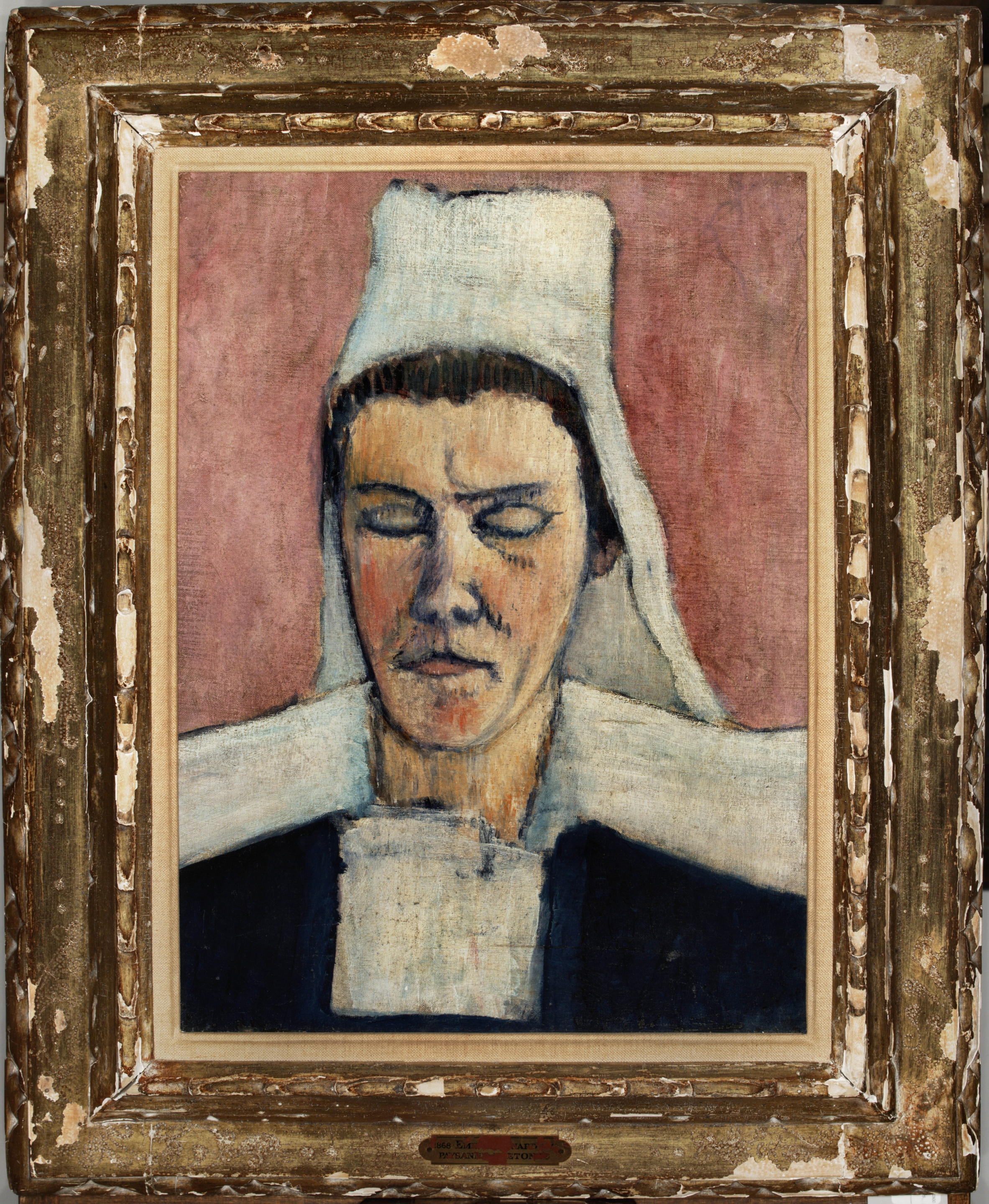
Bretonne sur fond rose

Description
Technical Description of the Work
Painted when Bernard was around 20 years old, this work stands out for its remarkable freedom of tone for its time.
It reveals striking artistic maturity and explores bold pictorial experiments that challenge conventions and anticipate the research he would later pursue with Gauguin in Pont-Aven. The stylized, silent female figure emerges against a nearly abstract pink background, devoid of shadows or superfluous detail. Sharp black contours, flat areas of color, and a reduced palette reflect a deliberate formal simplification. The Breton woman becomes an inner icon, absorbed in near-sacred introspection. The pink, far from naturalistic, expresses emotion: “Pink is not flesh, it is tenderness,” Bernard would write.
artist & context
Émile Bernard (1868–1941)
“Color is a vital necessity. It is a raw material as indispensable to life as water and fire.” — Émile Bernard, 1887
Born in 1868, Émile Bernard was one of the initiators of Synthetism, a movement he formalized in 1888 alongside Gauguin. From his earliest stays in Brittany, between 1886 and 1892, he developed a radical approach to painting: simplified forms, flat colors, and a rejection of naturalism. This work belongs to the foundational Pont-Aven period, in which Bernard sought to express an idea or emotion rather than faithfully reproduce reality. He transcends portraiture to reach a mental, almost spiritual image—foreshadowing the explorations of the Nabis and the bold chromatic experiments of Fauvism.
Movement
symbolic abstraction
A purified symbolic abstraction, conceived to resonate within an intimate space.
Synthetism, as defined by Bernard, aims to merge subject, idea, and style into a unified composition. It stands in opposition to Impressionism, which he considered overly reliant on direct observation, and instead proposes an abstraction drawn from nature. This painting fully embodies that approach: stylized forms, sharp contours, a reduced palette, and a uniform background. It reflects Bernard’s desire to create a purified pictorial language, where color becomes emotion, thought, and music. This movement paved the way for the formal innovations of the Nabis and anticipated the expressive use of color in Fauvism.
Interpretation
of the work
“Beauty is everywhere.” — Émile Bernard
Breton Woman on Pink Background is a pivotal work in Bernard’s artistic journey. It marks the transition from descriptive painting to a conceptual approach, where the figure becomes a symbol. The nearly abstract pink background isolates the silhouette and intensifies the spiritual dimension of the scene. The woman, silent and introspective, appears immersed in deep inner reflection. Bernard no longer seeks to imitate reality, but to extract its essence. Through formal simplification and the emotional charge of color, he composes a mental image—a modern icon. The dating around 1888 corresponds to Bernard’s first mature Synthetist works, confirming his role in the emergence of a revolutionary pictorial language.
Insight
curatorial note
A radical icon of early Synthetism—conceptual, chromatic, and spiritually charged.
The figure depicted in Portrait of Brittany Peasant wears a stylized coif, collar, and wimple typical of domestic servants from Aven—as confirmed by sources from the Musée de Bretagne and the Musée de Pont-Labbé. The coif and attire closely resemble those in Paul Sérusier’s Portrait of Marie Lagadu, painted in 1889 in Pont-Aven. Marie Lagadu, a servant at the Gloanec boarding house, is portrayed wearing the characteristic working costume of Breton domestic women. Since Émile Bernard only began staying in Pont-Aven from 1888 onward, the creation of this work can be situated between 1888 and 1892, the period during which he developed the principles of Synthetism. Stylistic analysis—flat color, stylized forms, emotional intensity—confirms that the painting fully belongs to this dynamic.
GALLERY
SPECIFICATIONS

Contact
