Kiki de Montparnasse

Description
Technical Description of the Work
Around 1920, Kisling consolidates a singular pictorial language, shaped by a decade of formal experimentation and major artistic encounters.
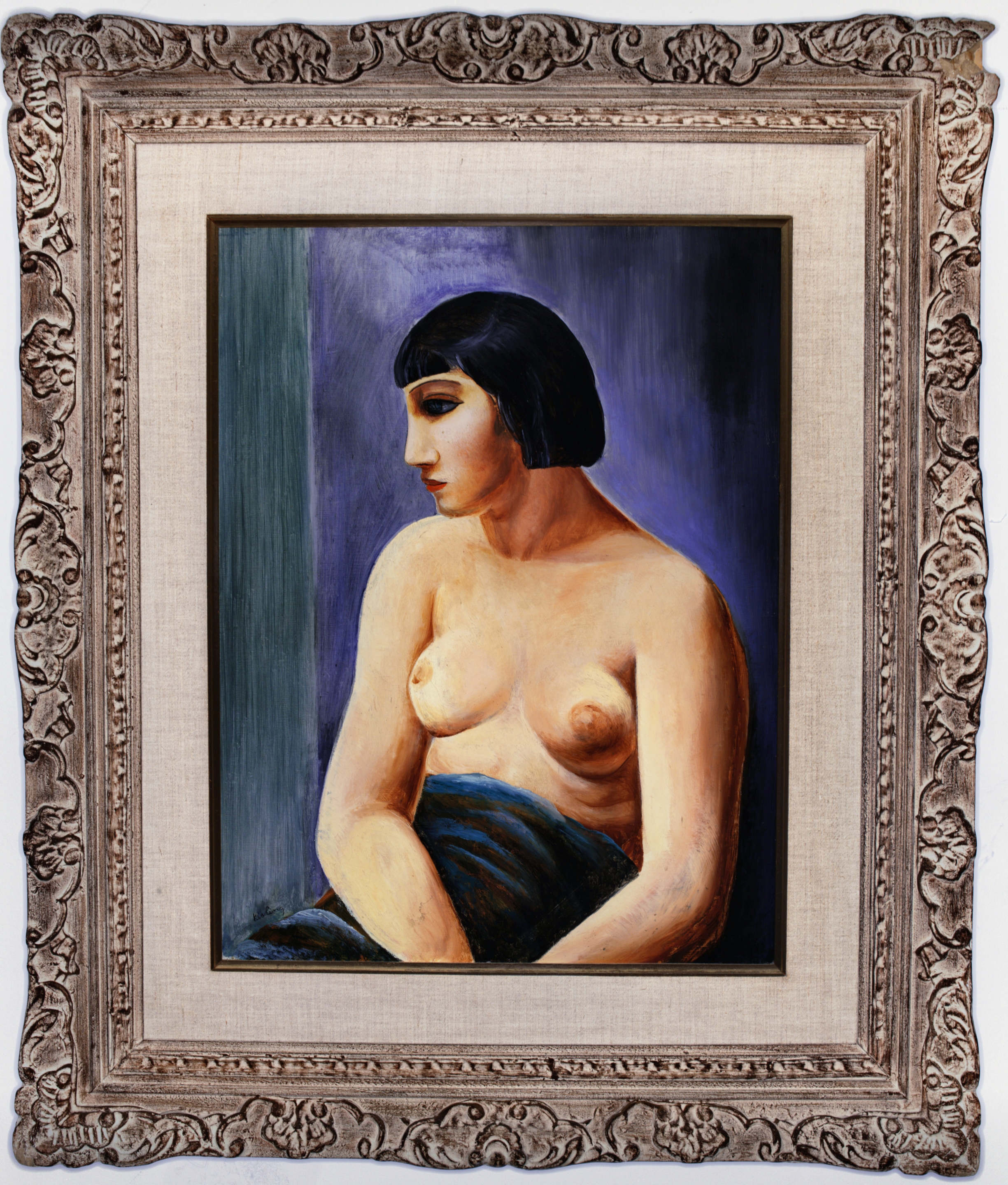
Based in Montparnasse, he paints a nude woman, seated and partially draped. The vaporous background contrasts with the warmth of the flesh, as if the body resists dissolution. The lowered face, straight fringe, and stylized features — straight nose, full lips, arched brows — establish a quiet restraint. Nothing is overstated; everything is contained. The execution is precise, the volumes full, the asymmetries embraced. Kisling seeks neither idealization nor academicism: he paints a body that is respected, inhabited, remembered. This work belongs to a series of female nudes from the 1920s, a period when he moves away from society portraits to explore a more intimate form of painting. Works such as Nude on Red Background (1917, Musée d’Art Moderne de Paris) and Seated Nude Woman (1922, Petit Palais in Geneva) reflect the same concern for stylized restraint and silent frontality.
artist & context
Moïse Kisling (1891–1953)
“Kisling paints the modern woman with grave tenderness, with inner light.” — André Salmon
In 1920, Moïse Kisling is a central figure of the École de Paris. Born in Kraków in 1891, he settles in Montparnasse in 1910, where he mingles with Modigliani, Soutine, Cocteau. Wounded at the front during the war, he obtains French citizenship in 1924. His first solo exhibition at Galerie Druet in 1919 marks a turning point: he gradually abandons commissioned portraits to pursue a more introspective form of painting. In postwar Paris, Kiki de Montparnasse embodies modern freedom. Kisling shares an intimate relationship with her in the early 1920s, a period during which she regularly poses for him. Their closeness fuels a series of silent, inhabited nudes. In Kiki de Montparnasse, everything suggests it is her: straight fringe, oval face, natural breasts. The painting becomes a discreet homage to a muse, and to a time when the female body became a manifesto of freedom and presence.
Movement
École de Paris
“The École de Paris is not a style, it’s a breath.” — Jean Cassou
Formally, this work belongs to the École de Paris, an informal movement of artists from around the world who settled in Paris between the wars. Kisling occupies a singular place within it: trained under the influence of Cubism and Cézanne, he develops a personal style marked by clear lines, full volumes, and muted colors. He distances himself from radical avant-gardes to return to a stylized, sensitive, structured figuration. This return to the figure, to the body, to silence, aligns with broader European trends of the 1920s, such as the “New Objectivity” and the “call to order.” Yet Kisling does not settle for modernized classicism. He imbues his nudes with rare emotional density. The body is not decorative — it is memory. He does not seek to represent a woman, but to capture a presence. The model’s silence becomes that of the painter — and perhaps of the viewer. The work does not aim to innovate, but to endure. It belongs to tradition, while renewing it through restraint, stylization, and inner light.
Interpretation
of the work
“She had eyes that looked beyond the eyelids.” — Robert Desnos, about Kiki
In Kiki de Montparnasse, Kisling does not paint an academic nude. He paints a memory, an imprint, a presence. The body is frontal, yet without provocation. Draped in dark fabric, it seems suspended between appearance and disappearance. The vaporous, cold background evokes a mental space more than a real setting. The contrast between warm flesh and icy backdrop creates a silent, almost metaphysical tension. The lowered face and absent gaze reinforce the impression of introspection. Each detail is treated with respectful precision: the natural fall of the breasts, the slight asymmetry of the shoulders, the softness of the lips. Nothing is idealized; everything is observed. Kisling paints as one remembers — faithfully, but without insistence. The model, likely Kiki de Montparnasse, becomes a figure of memory. She does not pose — she is. And in this silence, in this stillness, the work whispers something larger: the beauty of an inhabited body, the density of a presence, the light of a suspended moment.
Insight
curatorial note
A stylized nude, rare in its restraint — and perhaps one of the most silent portraits of the muse Kiki de Montparnasse.
Painted around 1920, this canvas belongs to a period when Moïse Kisling shared an intimate relationship with Kiki de Montparnasse, emblematic muse of the roaring Montparnasse. She posed for him repeatedly, in an artistic and personal closeness nourished by the district’s effervescence. The body depicted here — frontal, draped, stylized yet faithful — seems to be one he knows, observes, respects. The vaporous background, cool palette, and absent gaze establish a silent tension between presence and disappearance. The resemblance to Man Ray’s famous nude photograph of Kiki (1923–1924) is striking: oval face, straight fringe, natural breasts, clearly defined areolas, restrained posture. It becomes difficult to argue it is not her. Kisling does not name his model, but the precision of the features, the density of the gaze, and the restraint of the pictorial gesture suggest a lived relationship — that of a painter portraying not a woman, but a beloved presence. A rare, intensely inhabited work — inscribing in paint the trace of a cherished body, an intimate gaze, a vibrant era.
GALLERY
SPECIFICATIONS


Contact
