Oval with Points

Description
Technical Description of the Work
Henry Moore was around 70 years old when he conceived Oval with Points in 1968, a period of full artistic maturity.
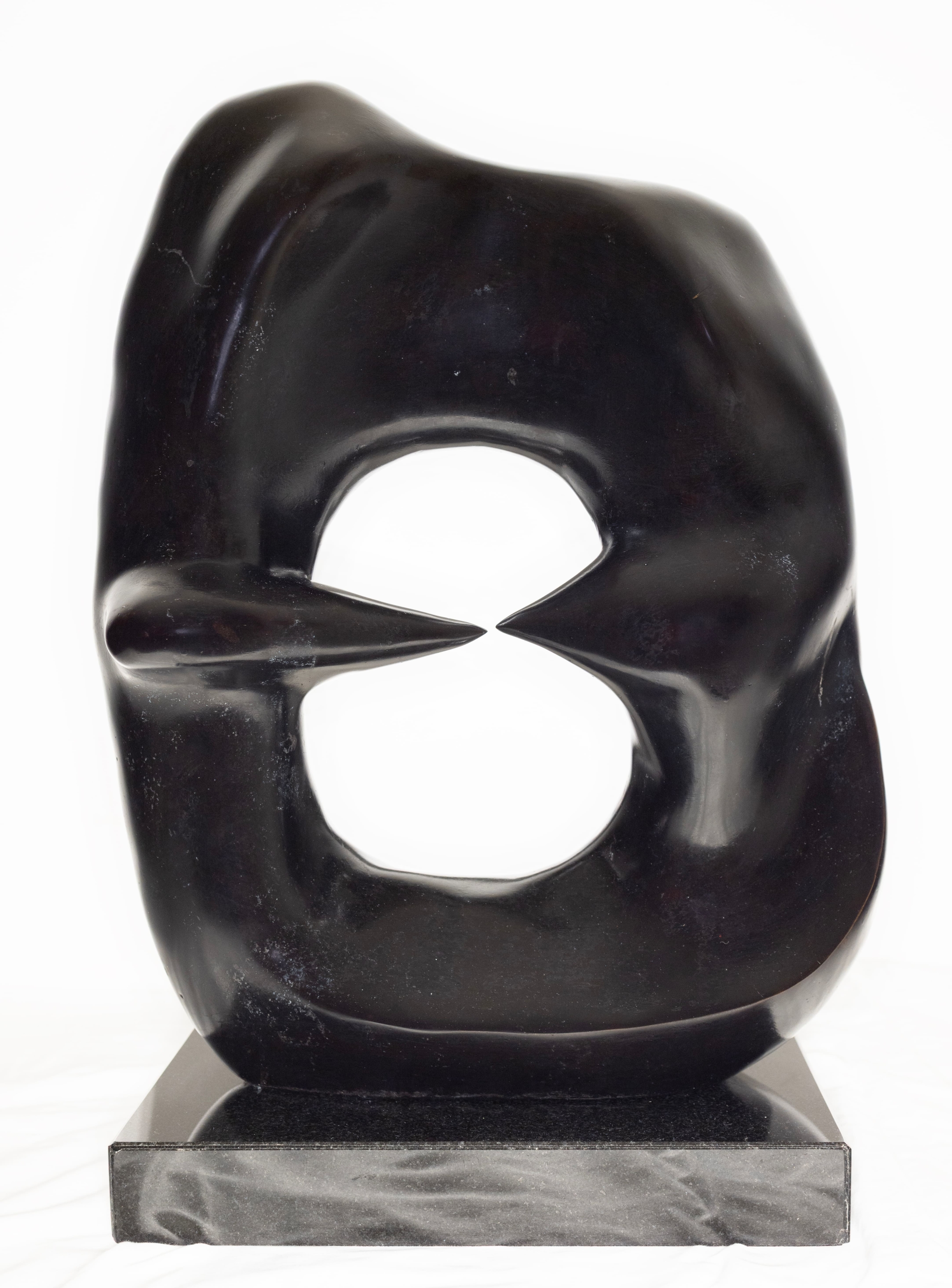
This bronze sculpture with black patina, measuring approximately 49.5 × 34.3 cm, belongs to a limited edition (2/6), signed and marked by the foundry. It presents an oval form pierced by a central void, with two opposing points that seem about to touch. This suspended gesture creates a dynamic tension between mass and void, between closeness and separation. The polished surface enhances the play of light, revealing the continuity of the volume and the sensuality of the material. This work belongs to a series of pierced organic forms developed by Moore from the 1930s onward, notably Three Points (1939–40) and Spindle Piece (1968), held respectively by the Henry Moore Foundation and the San Francisco Museum of Modern Art. The motif of nearly touching points is a recurring element in his formal vocabulary, evoking both the gesture of creation and the tension of living forms. The reduced format presented here corresponds to maquettes or intermediate casts produced alongside monumental versions intended for public spaces.
artist & context
Henry Moore (1898–1986)
“Sculpture is like a journey. You have to go through it to understand it.” — Henry Moore
By the late 1960s, Henry Moore was one of the most celebrated sculptors in the world. Born in 1898 in Yorkshire, he had lived through both World Wars, contributed to the modernization of British sculpture, and established a monumental and organic vision of art. In 1968, he received numerous public commissions, notably for parks, universities, and international institutions. This period was marked by intense formal research, nourished by his observation of nature, bones, stones, and shells. The direct inspiration for Oval with Points came from an elephant skull gifted by biologist Julian Huxley. Moore, fascinated by its cavities and volumes, saw in it an organic structure full of mystery and power. He transposed this natural form into an abstract, universal sculpture, where the void becomes latent energy. The artistic context of the time—between minimalism, land art, and postmodern abstraction—reinforced Moore’s singularity, as he remained committed to a stylized, deeply human figuration.
Movement
modern sculpture
“Moore’s abstraction is never cold: it breathes, it pulses.” — Jean-Louis Ferrier
Oval with Points is part of the British modern sculpture movement, often associated with the St Ives School or organic abstraction. Moore, though influenced by surrealism and primitivism, developed a unique language based on the tension between solid and void, between nature and memory. The work is formally classified in public collections as organic abstraction, yet it transcends strict categories: it is at once biomorphic, meditative, and monumental. Moore does not seek to illustrate, but to embody. He sculpts forms that evoke without naming, that suggest without imposing. Oval with Points exemplifies this approach: an open, taut, universal form that speaks of the body, breath, and relation. The central void becomes a space of dialogue, tension, and latency. The work does not impose itself—it invites. It belongs to a sculptural language that seeks not to dominate space, but to inhabit it.
Interpretation
of the work
“There is some anticipation of this action… like the spark that jumps across the gap.” — Henry Moore
The formal reading of Oval with Points rests on a sculptural tension masterfully controlled. Two points emerge from the central void, nearly touching but never meeting. Moore compares this gesture to that of God in Michelangelo’s Creation of Adam, or to the spark between two electrodes. This anticipation of contact creates latent energy, a silent dynamic. The void is not absence—it is a space of relation, memory, and breath. The oval form, soft and continuous, contrasts with the angularity of the points. The void is divided into two unequal zones, one suspended, the other anchored. Some see a stylized human figure—head and torso—others a mineral or skeletal structure. Moore does not decide: he leaves the work open to interpretation. This bronze, in its reduced format, condenses monumentality into an intimate scale. It becomes an object of contemplation, a sculpture at human scale, a memory of a suspended gesture.
Insight
curatorial note
The breath of the void — a sculpted tension, universal Oval with Points is one of the most emblematic works of Henry Moore’s mature period.
It condenses, in a reduced format, the full power of his sculptural language: tension between mass and void, between closeness and separation, between nature and abstraction. Inspired by an elephant skull and transposed into polished bronze, it becomes a universal form, both biomorphic and meditative. This sculpture does not seek to represent, but to embody. It speaks of the body without naming it, of breath without depicting it. It invites contemplation, relation, and listening to the void. Within Moore’s trajectory, it marks a rare synthesis between organic inspiration and formal mastery. It is both monument and murmur—a rare, intensely inhabited work that embodies the silent density, contained tension, and timeless resonance of a sculptural gesture fully realized.
GALLERY
SPECIFICATIONS

Contact
