Sans titre - Géométrique

Description
Technical Description of the Work
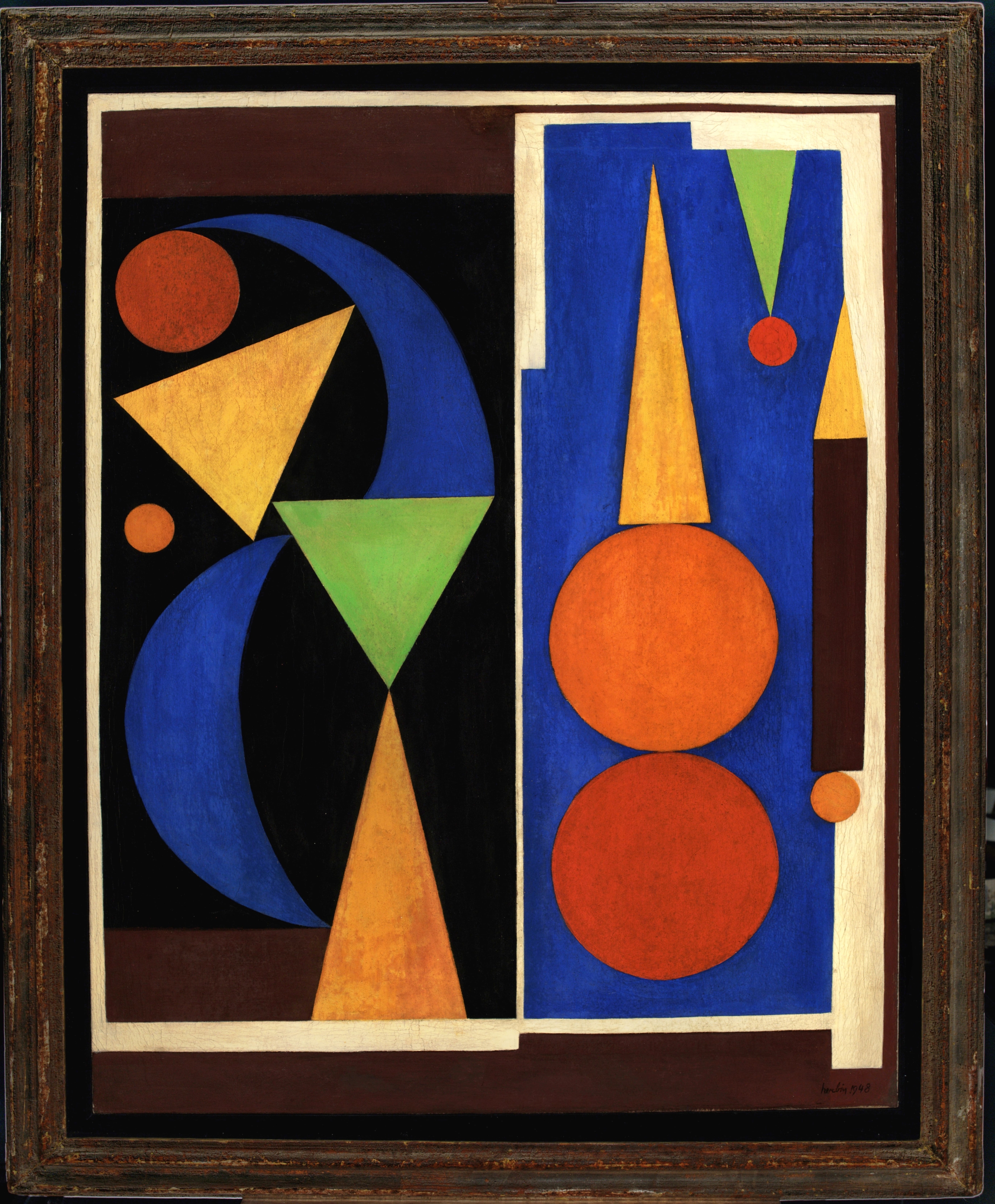
At the age of 66, Auguste Herbin created this geometric composition in 1948, at the heart of his codification period.
The canvas is divided into two vertical fields with marked contrasts, playing on the opposition between a dark background and a luminous plane. The arrangement of crisp, colorful geometric forms is built on a tension between dynamic asymmetry and structured balance. The overall effect generates a rigorous visual rhythm, based on repetition, variation, and verticality. The use of flat primary and secondary colors, combined with codified shapes, reflects Herbin’s “plastic alphabet” developed in 1946: a visual system in which each element carries symbolic, sonic, and expressive value. This 1948 work bears witness to an active phase of codification, where painting no longer represents but states — as an autonomous language.
artist & context
Auguste Herbin (1882–1960)
“Color is a vital necessity. It is a raw material as indispensable to life as water and fire.” — Auguste Herbin, 1949
Born in 1882, Auguste Herbin is a major figure of abstraction in France. After early work influenced by Fauvism and Cubism, he turned in the 1930s toward a rigorous form of abstraction based on pure form and color. In 1946, he formalized his plastic alphabet — a system linking letters, geometric shapes, colors, and sounds — in a quest for universal language. The 1948 painting belongs to this intense phase of research, in which Herbin no longer conceived painting as image, but as a system of signs. This approach emerged in a postwar context marked by the desire to reconstruct an autonomous and universal artistic language.
Movement
geometric abstraction
A coded abstraction, stretched between formal rigor and chromatic vibration.
This work belongs to geometric abstraction, a movement that emerged in the 1910s and was reactivated after 1945. Herbin played a singular role by combining constructivist rigor with heightened chromatic sensitivity. His plastic alphabet sets his practice apart from other abstract artists: each shape and color corresponds to a letter, a sound, an emotion. The 1948 composition embodies this ambition: it arranges elements according to a precise visual syntax, where structure becomes language and color becomes thought. It is not decorative, but a system of pictorial communication.
Interpretation
of the work
“Painting must be a language, not a decoration.” — Auguste Herbin, 1949
The canvas functions as a visual score. On the left, forms unfold in an oblique dynamic against a dark background; on the right, they are vertically ordered on a luminous field. This tension between asymmetry and symmetry, between density and clarity, creates an internal rhythm that goes beyond mere juxtaposition. Each element carries meaning, inscribed within a plastic grammar. The work is not read as an image, but as a signifying structure — where abstraction becomes language.
Insight
curatorial note
A visual manifesto — Herbin turns painting into an autonomous, vibrant, and universal language.
This 1948 composition bears a striking resemblance to Soleil I (1949), held at the Musée départemental Matisse in Le Cateau-Cambrésis. Both works share a vertical structure, a saturated palette, and a syntax rooted in the plastic alphabet. Created the same year Herbin presided over the Salon des Réalités Nouvelles and published its manifesto, this painting embodies his radical commitment to a non-figurative, non-objective abstraction conceived as a system of signs. It reflects a pictorial thought in which each form becomes a sign, each color a vibration — an abstraction conceived not as style, but as language.
GALLERY
SPECIFICATIONS

Contact
