Toilette de la mère

Description
Technical Description of the Work
Pablo Picasso was 24 years old when he created Toilette de la mère in 1905, at the heart of his Rose Period.
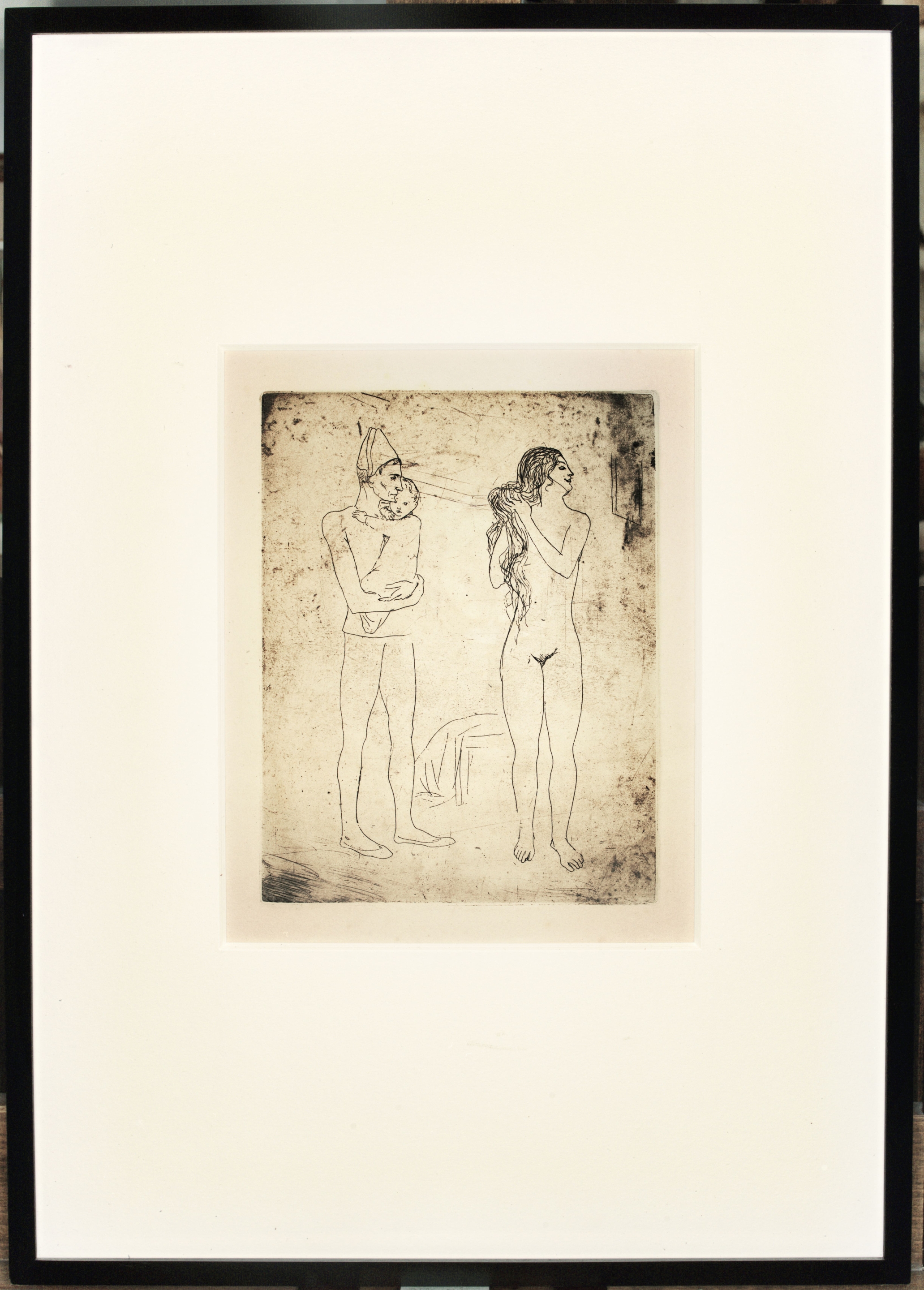
This etching on Van Gelder paper, printed in 1913 by Ambroise Vollard, belongs to the celebrated Suite des Saltimbanques. It depicts an intimate scene: a man holding a child, a nude woman beside him, in a stripped-down, silent, almost suspended composition. The graphic treatment is minimal, volumes are suggested, gestures restrained. Far from a realistic family portrait, the print evokes a universal motherhood, shared tenderness, and a humanity in transit. The woman’s simple, everyday gesture becomes a sacred ritual. This work resonates with other prints from the suite, such as La famille de saltimbanques and Le repas frugal, held by the Musée national Picasso-Paris and MoMA. All share a similar economy of means, poetic gravity, and a quest for dignity within fragility.
artist & context
Pablo Picasso (1881–1973)
“Art washes away from the soul the dust of everyday life.” — Pablo Picasso
In 1905, Picasso was living in poverty at the Bateau-Lavoir in Montmartre. He frequented the Cirque Medrano, observing itinerant performers in moments of rest, doubt, and solitude. He had not yet founded a family, but the theme preoccupied him deeply. During his Rose Period, family became a recurring motif—not as lived experience, but as inner projection. He explored motherhood, tenderness, and closeness through anonymous figures, often inspired by the saltimbanques. These characters, united not by blood but by condition, embody a fragile humanity in search of connection. Ambroise Vollard, the suite’s publisher, played a decisive role in disseminating these prints, which mark a pivotal moment in Picasso’s graphic work. Toilette de la mère thus forms part of a meditation on family as a space of care, shared silence, and exposed dignity.
Movement
Symbolism and poetic realism
“The saltimbanques are the painter’s brothers: they live in the gaze, but outside the world.” — Jean Clair
Toilette de la mère belongs to Picasso’s Rose Period, often associated with late Symbolism and poetic realism. Though predating Cubism, the work already reveals a stylized approach, an economy of line, and a rejection of the picturesque. It is formally classified in public collections as poetic abstraction, yet it transcends such categorization through its metaphorical depth. Picasso does not aim to depict a domestic scene, but to suggest a human condition—that of the artist, the outsider, the imagined parent. The choice of etching, a demanding and introspective medium, reinforces this meditative quality. The work becomes a space of projection, a site of memory, a figuration of tenderness on the margins. It belongs to a strand of modern art that does not describe, but reveals.
Interpretation
of the work
“I do not paint what I see, I paint what I think.” — Pablo Picasso
In Toilette de la mère, the scene is reduced to its essence: three figures, a bare space, an intimate gesture. The nude woman, standing, embodies a universal motherhood—exposed yet protective. The man, holding the child, appears withdrawn, a silent witness. He may be the artist himself, observing without belonging, present without imposing. The graphic treatment is minimal: fine lines, suggested volumes, no background. This formal restraint creates an atmosphere of quiet reflection and suspended grace. The banal gesture becomes sacred, the everyday becomes ritual. The work does not narrate a story; it offers a meditation on family, solitude, and tenderness. It engages with other prints in the suite, and with contemporaneous paintings such as La famille d’acrobates avec singe (1905, Musée Picasso), where the same tension between intimacy and wandering is present.
Insight
curatorial note
Tenderness on the margins — a dreamed motherhood, a humanity in transit Toilette de la mère is one of the most poignant prints in the Suite des Saltimbanques.
Created at the age of 24, it reveals Picasso’s early sensitivity to silent figures, restrained gestures, and fragile presences. It does not depict a real family, but a possible one—dreamed, projected, meditated. This work condenses the themes of the Rose Period: graphic stylization, poetry of the everyday, kinship with the excluded. It marks a decisive stage in Picasso’s printmaking and anticipates his Cubist explorations through its economy of means and evocative power. It is both intimate and universal, modest and essential.
GALLERY
SPECIFICATIONS

Contact
