Untitled : Abstract Composition

Description
Technical Description of the Work
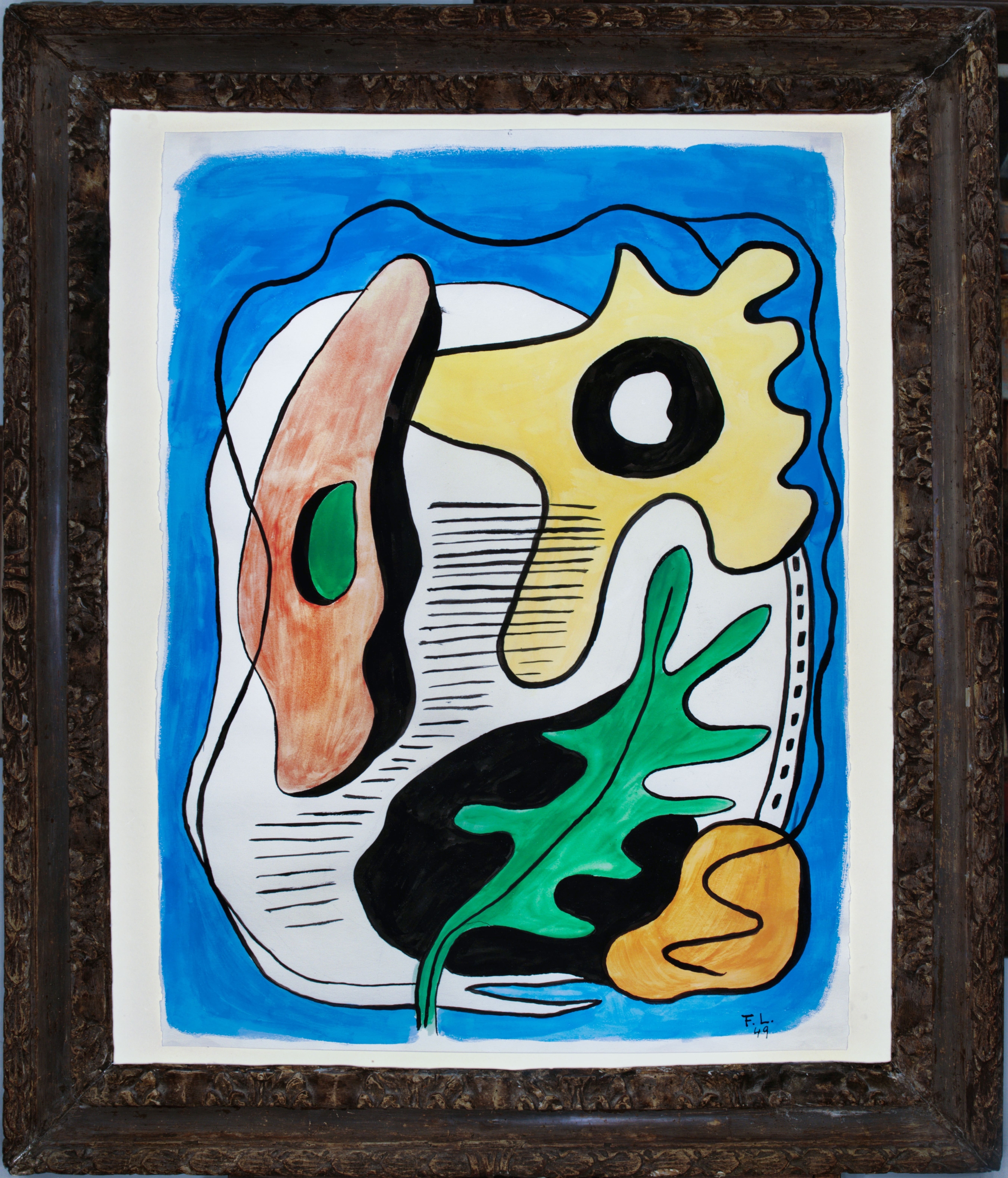
Fernand Léger was 68 years old when he created this generously scaled gouache on paper, which exceeds the usual dimensions of preparatory studies and fully asserts its status as an autonomous work.
Léger explored this medium in several compositions of similar scale, held notably at the MoMA (New York) and the Centre Pompidou (Paris), created both as independent pieces and as part of research related to stained glass and mosaics.
artist & context
Fernand Léger (1881–1955)
“Color is a vital necessity. It is a raw material as indispensable to life as water and fire.” — Fernand Léger, 1937
In 1949, Léger returned to France after his wartime exile in the United States. He became deeply engaged in reflecting on the social role of art. This period was marked by postwar reconstruction, debates around monumental art, and a desire to bring art closer to the people. He opened a school in Montrouge, then in Paris, and took part in public decorative projects. This work coincides with his retrospective at the Musée national d’Art moderne (1949), which celebrated his evolution toward a colorful, rhythmic, and assertive abstraction. At the time, Léger developed a practice of direct observation of the real, notably during walks where he collected stones, leaves, and modest objects, which he transposed into a plastic syntax.
Movement
biomorphic abstraction
A jubilant biomorphic abstraction, conceived to radiate within a private space.
This work belongs to the graphic abstraction Léger developed after 1945. While officially associated with Cubism in public collections (Centre Pompidou, MoMA), it departs from it through a freer formal vocabulary, bold color fields, and biomorphic shapes. Léger sought to create an art that was legible, direct, grounded in color and rhythm, and capable of engaging the viewer without relying on narrative. He did not depict — he composed. This gouache embodies the ambition of an affirmative art, conceived to resonate within a space scaled to its own dimensions.
Interpretation
of the work
“Beauty is everywhere.” — Fernand Léger
The biomorphic forms, though non-figurative, evoke organic fragments — stylized plants, cells, nuclei — drawn from a sensitive observation of the real. The interplay of flat color fields and bold black outlines creates a graphic tension, almost musical in nature. Sinuous lines establish a fluid rhythm, like a visual score. This approach is directly linked to his research on the figure-object and his practice of collecting natural elements. The generous format lends the work a strong presence, while the paper support preserves a gestural immediacy inherent to the medium. The composition functions as an autonomous fragment of visual thought — both concentrated and expansive.
Insight
curatorial note
A jubilant biomorphic abstraction — rare in scale, shaped by direct observation, and emblematic of Léger’s postwar visual manifesto.
This gouache reflects a fully realized practice in Léger’s work, where paper becomes a medium for direct creation. Gouache, by nature demanding, requires swift, confident execution. This composition results from a controlled gesture, shaped by years of experience and a refined visual language. It embodies Léger’s conviction that art should address the eye with clarity, rhythm, and vitality. Without relying on monumental scale, this work distills the principles of his postwar abstraction: a jubilant graphic syntax, bold color, and a commanding presence.
GALLERY
SPECIFICATIONS

Contact
