Untitled

Description
Technical Description of the Work
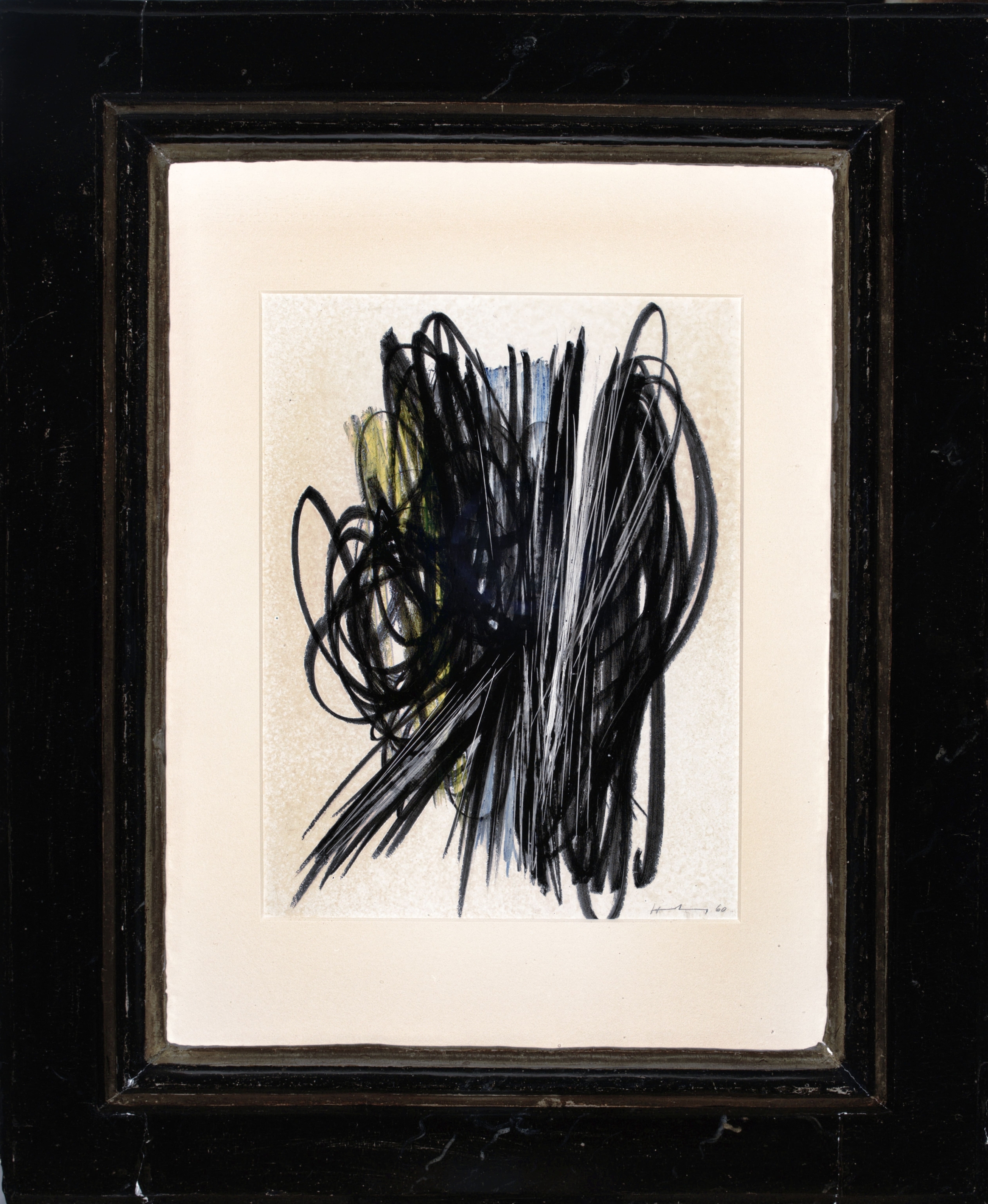
Created at the age of 56, this work belongs to a series of pastels on paper produced between 1959 and 1961, a period during which Hartung asserted the autonomy of his graphic works Paper becomes a fully-fledged space for creation, freed from any preparatory function.
The gesture is free, nervous, at times swirling, structured by volutes and bundles that express a tension between dispersion and concentration. This type of composition, emblematic of his gestural abstraction, is represented in several major institutions, including the Centre Pompidou, which holds a significant group of works from this period.
artist & context
Hans Hartung (1904–1989)
“I want to reach the zone of the not-yet-created.” — Hans Hartung
In 1959, Hartung moved into a new studio in Paris, marking a decisive phase in his artistic evolution. In 1960, he was awarded the International Grand Prize for Painting at the Venice Biennale, cementing his role in the European avant-garde. This moment coincided with a transformation in his practice: his works on paper ceased to be preparatory sketches and became autonomous artworks. The abstraction he explored was pure, freed from any figurative or intimate reference, in search of a new visual language.
Movement
abstraction
“It pleases me to act on the canvas. It’s that urge that drives me: the urge to leave the trace of my gesture.” — Hans Hartung, 1951
This work belongs to the gestural abstraction movement, which Hartung helped redefine through an approach that was both physical and rigorous. Though the gesture may appear spontaneous, it is in fact informed by a mathematical sensibility, notably toward the golden ratio. In the 1960s, Hartung abandoned the graphic volutes of his early years in favor of more taut structures, while retaining a raw energy. His abstraction seeks neither to represent nature nor to evoke Eastern calligraphy, but rather to capture the essence of movement and energy.
Interpretation
of the work
“What interests me is the gesture—its speed, its tension, its breath. The stroke is not a line, it’s an impulse.” — Hans Hartung, circa 1965
This pastel reveals a tension between asceticism and intensity. Black volutes and bundles intertwine in a complex gestural architecture, conveying an inner pulse. The touches of yellow and blue, applied beforehand, are almost entirely covered by black, yet remain visible through overflow or transparency. They do not decorate—they modulate. Through contrast, they amplify the vibration of the stroke, structure the space, and redirect the viewer’s gaze across the composition. The paper becomes a formal laboratory, where abstraction represents nothing but expresses everything: rhythm, silence, and brilliance.
Insight
curatorial note
An autonomous, nervous, and rare work—where gesture becomes architecture This 1960 pastel embodies a fully realized abstraction, created at a pivotal moment in Hans Hartung’s career.
Far from a preparatory drawing, it asserts itself as an autonomous work, born in the wake of the Venice Biennale Grand Prize. The composition combines two rarely united graphic vocabularies: soft, swirling volutes and taut, almost architectural bundles. Black dominates, affirming the gestural trace with intensity, while yellow and blue introduce chromatic breathing spaces. Here, paper becomes a field of invention, where gesture does not describe but constructs tension. The work pulses, vibrates, rises. It condenses the principles of post-Biennale gestural abstraction: freedom of stroke, formal rigor, immediacy of language.
GALLERY
SPECIFICATIONS

Contact
